

The Weight of What We Throw Away
Sep 2026 Khizra Jamil Khan (Sustainability Communications and Research Associate)
The time that it will take you to read this article, there is a high possibility that kilos of fresh produce have already spoiled before reaching markets. In this same time, left over food at a wedding buffet has been thrown away instead of being redistributed to the poor and needy. In a country, where 36.9% of the population is vulnerable to food insecurity [1] and more than 70% of the people below the poverty line, food waste becomes one of the most integral environmental cost and opportunity to address.
However prevalent this issue may seem, Pakistan’s struggles relating to climate relate heavily with monsoon patterns, heat waves, urban flooding, and energy shortages. In the extremely important conversations of climate change, food waste remains a topic conveniently excluded from conversation. Globally, around 13.2% of food produced is lost between harvest and retail, while an estimated 19% of total global food production is wasted in households, in the food service and in retail all together [2].
The World Food Program USA states that global hunger is not a result of there being a lack food, rather a result of food being lost through the supply chain resulting in wastage equivalent of around $1 trillion dollars [3]. Food loss and Food waste, thus, can be conveniently divided as a lower income country versus high-income country problem. But what of countries like Pakistan that exist in a state of limbo, being agricultural dependent but having different spending patterns in areas of concentrated wealth?
In Pakistan, the central issue is highlighted as a lack of conservation method. It is estimated that post-harvest losses are between 35%-40% [4]. Furthermore, Pakistan experiences a wastage of almost 15%-20% in wedding seasons according to estimates. This waste range can increase 20%-25%[5] depending on number of guests invited. In most cases, this food is wasted when guests help themselves to more food than they can eat. Food waste is furthered by general grocery practices where items are bought on the convenience of their availability and stored poorly, rather than being a conscious decision of what food will definitely be finished.
What this reveals in Pakistan is a problem rooted throughout the value chain. From farms to transport systems to urban households laden with inefficiencies at every stage, food insecurity becomes a matter of urgency. Since 2010, food prices in Pakistan have remain at an all time high while purchasing power of the lower income classes has further declined. [6] Effects in the value chain of food supply affect multiple supply chains simultaneously. Not only do these effects show themselves economically, they materialize in terms of water stress, where wastage of food mean wasting the vast majority of water and energy required in its production.
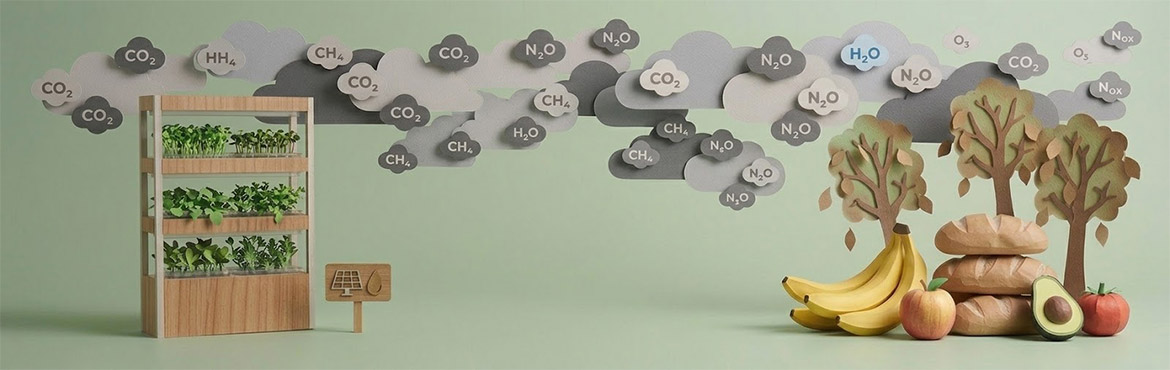
The environmental cost of food production and waste grow when taking into account the production of greenhouse gases in food production/procurement. What most people fail to realize is that some of the most basic foods eaten in their daily lives carries several units of GHG emissions. A perfect example is Beef, accounting for the highest food based carbon footprint, approximately 15.5 kg CO2 per 100grams of serving. While food is a basic human necessity, the scale at which it is produced, and ultimately wasted, means its environmental impact cannot be overlooked. In fact, food loss and waste account for nearly 8–10 % of global greenhouse gas emissions, making it a significant but often ignored contributor to climate change. [7]
Systematic inefficiencies elevate the drastic consequences of food waste. Addressing these inefficiencies does not require major technological shifts, but rather more coordinated efforts in how we produce, distribute, improve transport, and handle post-harvest losses. Agricultural and urban interventions are required to curb the losses we face to make an immediate and tangible impact. At the same time, excess consumer consumption requires mirrors inefficiencies in a different form. This does not stem from a structural issue, rather heavily depends on individual mindsets and cultural traditions around food consumption.
Reframing food waste as both a climate and behavioural issue moves it beyond policy discussions and into everyday decisions. In a recent internal workshop conducted with National Foods Limited on food waste and climate action, many participants acknowledged that their food waste occurs unconsciously without understanding its broader impacts. Small, consistent changed, such as only purchasing enough to consume, improving household storage and being mindful of portion sized, can amount to saving an estimated $120-$300 billion per year globally[8].
At the time of rising inflation and worsening of socio-political strains, Pakistan does not have the luxury to overlook a problem so immediate and solvable. Urban areas of Pakistan have witnessed an increase in food insecurity from 9.22% to 20.58%. [9] Reduction of these pressures will not yield results overnight, but it can deliver tangible relief by easing pressure on households, improving food availability, and reducing the environmental cost. In its current standing, Pakistan is wasting away into a food crisis without any excuses.
In a country where people are struggling to figure out their next meal, we can no longer afford to waste the one on the table.
[1] https://dailytimes.com.pk/998469/wastage-at-pakistani-weddings/
[2] UN International Day of Awareness on Food Loss and Waste Reduction, 20 September https://www.un.org/en/observances/end-food-waste-day
[3] https://wfpusa.org/news/food-loss-vs-food-waste-primer/
[4] Post-harvest losses in different fresh produces and vegetables in Pakistan with particular focus on tomatoes Nida Firdous
[5] https://dailytimes.com.pk/998469/wastage-at-pakistani-weddings/
[6] https://dailytimes.com.pk/998469/wastage-at-pakistani-weddings/
[7] Hannah Ritchie (2020) – “Food waste is responsible for 6% of global greenhouse gas emissions” Published online at OurWorldinData.org.
[8] https://www.wri.org/insights/reducing-food-loss-and-food-waste
[9] https://www.brecorder.com/news/40400685
Telephone: 021-35630528-29
Fax: 021-35630530

